
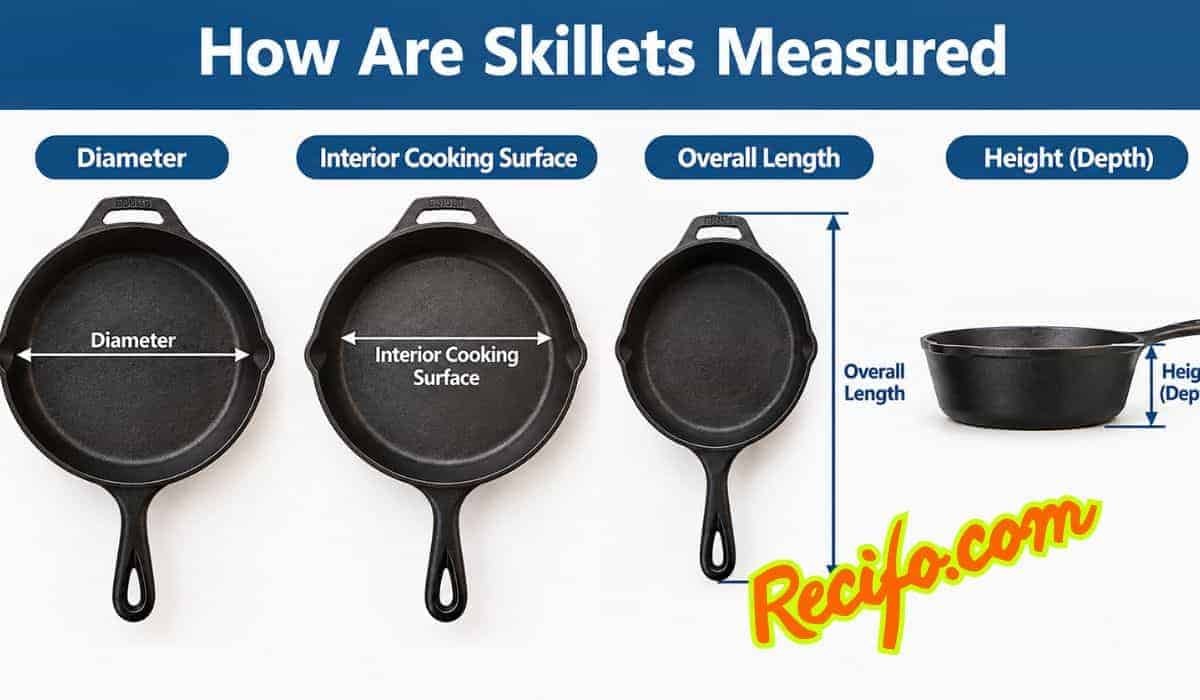

The standard rule for measuring skillets is from the top inner rim to the opposite top inner rim across the widest point. This measurement ignores the handle and the cooking surface entirely. A standard 10-inch pan usually gives you only about 8 inches of actual flat cooking space.
Table of Contents
The quick way skillets are measured
- Measure straight across the top rim with a stiff ruler, ignoring the handles and pour spouts.
- Expect the flat cooking bottom to measure 1 to 2 inches smaller than the stated rim size.
- If a skillet has flared sides, check the base size on the box so it matches your stove burner.
- Count the handle only if you need to know if the pan fits inside an oven or a cabinet.
- Read European pan labels in centimeters; a 28-centimeter pan equals roughly 11 inches across the top rim.
Why skillet makers size from the rim?
Pan makers size cookware by the top opening because metal forming starts with a flat circular disc of metal. During metal stamping and pressing, that initial disc diameter helps establish the final pan dimensions once the walls are drawn upward. Standard sizes like 8, 10, and 12 inches refer to this top boundary. It’s an industry tradition that also lets brands sell matching lids, since a lid rests on the upper rim rather than the pan floor.
The trade-off of this system is that top measurements hide the real cooking area. Cookware walls flare outward at different angles depending on the pan’s intended purpose. Omelet pans have low, gently sloping sides to let spatulas slide underneath eggs, which creates a very small flat floor. Sauté pans feature straight, vertical walls, meaning their cooking surface matches the stated rim measurement closely.
This sizing method creates an honest limit for the cook: this varies by model — check the label or use a ruler across the flat base before buying. If the base is too large for your heat element, the outer edges stay cool and your food browns unevenly.
When the answer is different
Sloped sides, vintage numbering, and varied kitchen tools mean a simple diameter check across the top rim doesn’t always tell the whole story.
| Situation | What changes | What to do instead |
|---|---|---|
| Vintage cast iron pan | A stamped number isn’t inches | Check manufacturer charts for old stove-hole sizes |
| French sauté pan | Straight sides make base match rim | Measure either edge since base equals top |
| Induction cooktop use | Magnet only senses the flat bottom | Measure the flat base to match burner ring |
| Oven baking with pan | Total length includes the handle | Measure outer edge including the handle length |
| Metric cookware packaging | Size is listed in centimeters | Divide centimeters by 2.54 to find inches |
| Square grill pan | Corner-to-corner width is larger | Measure flat side to opposite flat side |
How to do it properly
- Place the empty skillet flat on a steady counter with the cooking surface facing directly upward toward you.
- Hold a rigid metal ruler across the absolute center of the pan from one inside upper rim to the opposite side.
- Note the exact top diameter in inches, which gives you the official retail size used on packaging and store displays.
- Flip the skillet upside down so the exterior flat bottom faces up toward the ceiling.
- Lay the ruler across the flat circular bottom, measuring only the area that actually contacts the stove surface.
- Record this second number to verify that your stove’s electric coil or induction ring covers the base completely.
- Measure from the far outer pan edge to the tip of the handle to confirm it fits inside your home oven.
The mistakes that ruin it
- Buying an induction skillet by its top rim size, which causes weak heating because the actual magnetic base is too small for the burner.
- Measuring across pour spouts on cast iron, which adds an extra half-inch and leads to buying the wrong replacement lid size.
- Assuming vintage cast iron numbers mean inches, which results in buying a pan too big or small for your storage rack.
- Measuring the outside bottom when buying a replacement glass lid, which results in a lid that falls into the skillet.
Frequently asked questions
Does skillet size mean the top or the bottom?
It means the top inside rim. Cookware brands measure the widest opening across the top edges of the pan walls, not the flat surface where food cooks. A 12-inch skillet usually features a flat cooking floor that measures around 10 inches across.
Why is my 10 inch skillet only 8 inches on the bottom?
The walls flare outward to help moisture escape and allow spatulas to flip food easily. Sloped sides push the top rim out much farther than the base. Straight-sided sauté pans avoid this gap, keeping the top and bottom widths nearly equal.
How do you measure cast iron skillets?
Measure across the top rim from edge to edge, excluding the handle and pour spouts. If you see an embossed number like 8 on the iron, that refers to the old wood-stove hole size, not an 8-inch diameter. Check the physical rim with a ruler.
What happens if my skillet base is bigger than the burner?
The food along the outer edges of the pan cooks much slower than the food in the center. Thin aluminum skillets warp quickly under this uneven heat stress. Thick cast iron handles the size mismatch better, but still develops a cool outer ring.
Can you use a 12 inch skillet on an 8 inch burner?
Yes, if you let the pan preheat over medium-low heat for roughly 5 minutes to distribute warmth evenly. Doing this with cast iron or heavy clad stainless steel works reasonably well, but thin, cheap nonstick pans will scorch in the center and remain cold outside.
Is skillet size measured with the handle included?
No, retail pan measurements never include the handle length. You should only measure from the tip of the handle to the opposite outer rim if you need to check whether the skillet will clear your oven door or fit into a specific kitchen cabinet.
Leave a Reply